
How to Become an ICU Nurse
One or two patients, every system tracked in real time, and the fastest legitimate route into the highest-paid corners of nursing.

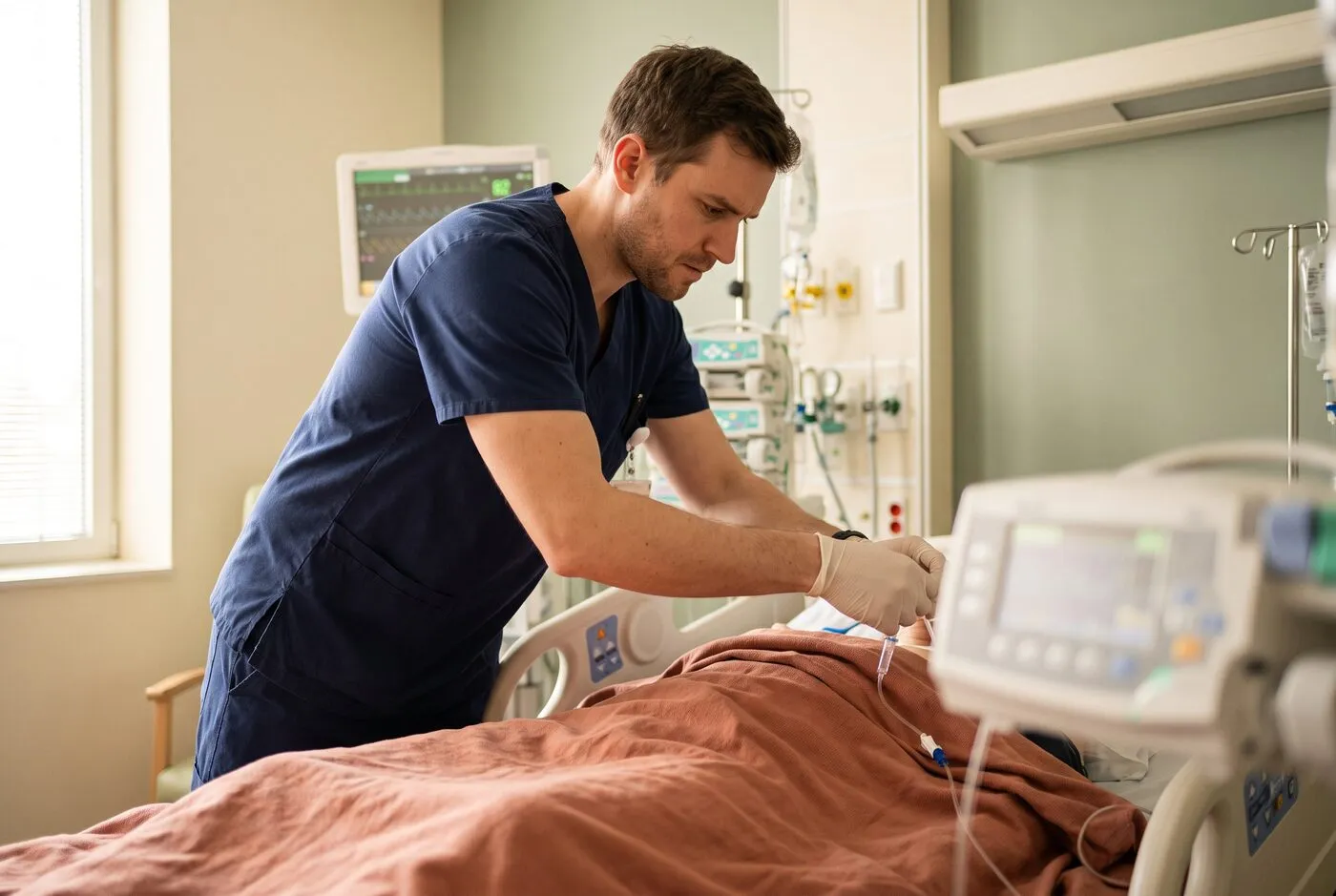
Here is how to become an ICU nurse: get your RN license, spend one to two years building assessment skills through either a new-grad ICU residency or a med-surg unit first, land an ICU position, then earn CCRN certification once you have the required critical-care hours. The Bureau of Labor Statistics does not track ICU nurses as a separate occupation. They are counted inside the broader registered nurse category, where the national median is $97,550 a year. But acuity pay, night and weekend differentials, and certification bonuses routinely push experienced ICU nurses well above that median.
ICU nursing is not a specialty you fall into. It is the unit new grads compete hardest for and experienced nurses transfer into on purpose, because it also happens to be the fastest route into the highest-paid corners of nursing: CRNA school, acute-care nurse practitioner tracks, and the best-paying travel contracts. If you want the ceiling nursing has to offer, you go through the ICU first.
What an ICU nurse actually does
An ICU nurse manages one or two patients at a time, never more. That ratio is the entire point of the unit: the patients are sick enough that continuous assessment is not optional. A single ICU nurse might be titrating a norepinephrine drip to hold blood pressure, watching a ventilator's pressure and volume settings, running an arterial line for real-time blood draws, and reassessing neuro status every hour, sometimes every fifteen minutes if the patient is unstable. When a patient codes, the ICU nurse is often the first person compressing a chest or pushing epinephrine, not waiting for a rapid response team to arrive.
Compare that to a med-surg floor, where one nurse might carry five or six patients stable enough to walk to the bathroom and ask for ice chips. Med-surg nursing is about volume and triage: who needs you most right now, out of six people. ICU nursing is about depth: one or two patients, every system tracked continuously, because the margin for error is measured in minutes. Neither is easier. They are different jobs wearing the same license.
A typical ICU shift runs twelve hours and starts with report on ventilator settings, drip rates, and the plan for the day, usually a wean, a procedure, or a family meeting about goals of care. Hours disappear into titrating medications, documenting neuro checks, turning and repositioning patients who cannot move themselves, and talking to families who are frightened and need someone to translate what the monitors mean. Some shifts are quiet. Others are three codes back to back. An ICU nurse has to be steady through both.
How to become an ICU nurse
Becoming an ICU nurse starts with an RN license, and how you get there matters. Large academic medical centers with the biggest ICUs increasingly prefer or require a BSN, especially at magnet-status hospitals, so if you are choosing a program, look at the best BSN programs in your area rather than defaulting to the cheapest ADN. An ADN still gets you licensed and hired at many community hospitals, but it can close doors at the tertiary centers with the sickest patients and the most training resources.
From there you have two real paths into the unit. Some hospitals run new-grad ICU residencies, structured year-long programs that take you straight from nursing school into critical care with heavy preceptorship. These are competitive and clustered at bigger hospitals, but they are the fastest route in if you get one. The more common path is spending one to two years on a med-surg or step-down floor first, building assessment skills, time management, and the instinct for when a patient is quietly going bad before the monitor confirms it. Charge nurses on ICU hiring committees often prefer this route, because it means you have already survived a heavy patient load without a preceptor holding your hand.
Once you land the ICU job, expect another six months to a year of orientation before you run full assignments solo. Somewhere in your first one to two years in the unit, once you have logged the required critical-care hours, you sit for the CCRN exam through the American Association of Critical-Care Nurses. It is not required to work in the ICU, but most hospitals pay ICU nurses a certification differential for it, and it signals to every future employer, CRNA program, or travel agency that you can handle acuity without supervision.
ICU nurse salary and outlook
Here is the honest number: the Bureau of Labor Statistics does not publish a separate salary for ICU nurses. Critical care is not its own occupation code. ICU nurses fall inside the broader registered nurse category (SOC 29-1141), which covers 3,379,720 RNs nationally and carries a median annual wage of $97,550, or $46.90 an hour, as of May 2025. Anyone quoting you an official "average ICU salary" figure from a government source is making it up.
What the data does support is that experienced critical-care nurses sit toward the upper half of that range in practice. Acuity-based differentials, night and weekend shift premiums, and CCRN certification pay all stack on top of base RN wages, and ICU units disproportionately staff nurses with the tenure to earn them. The RN 75th percentile nationally is $112,350 and the 90th percentile is $137,470, and that is the realistic band for a certified ICU nurse with a few years in the unit, not the flat median. New grads, by contrast, usually start closer to the 25th to 50th percentile ($80,330 to $97,550) until shift differentials and certification move the number. For the full breakdown by experience and shift, see the ICU nurse salary page.
RN employment overall is projected to grow 6% from 2022 to 2032, and critical-care units are rarely the first place hospitals cut, since shorter average hospital stays keep pushing patients toward higher acuity. That keeps demand for trained ICU nurses steady even in years when general nurse hiring slows.
The ICU as a career gateway: CRNA, NP, and travel nursing
Here is the part most career guides skip: for an ICU nurse, that experience is not just a job, it is a prerequisite. Every CRNA program in the country requires it, typically a minimum of one year in critical care, and competitive applicants usually show two to three. That requirement exists because nurse anesthesia is built on exactly the skills ICU nurses already have: managing hemodynamics, reading a ventilator, and reacting to a crashing patient without panicking. If you want to know how to become a CRNA, the honest answer is that it starts in the ICU, not in anesthesia school. CRNAs carry a national median salary of $236,590, more than double the RN median, and you can see the full picture on the CRNA salary page.
ICU time also strengthens acute-care nurse practitioner applications, since those programs want clinical judgment under pressure, not just clinical hours. And it is the credential travel agencies pay the most for. ICU and other high-acuity specialties routinely command the strongest travel nurse contracts, because hospitals facing a staffing gap in the ICU will pay a premium rather than run short on the unit where mistakes are least forgivable. This is the real reason ambitious ICU nurses compete hard for ICU openings right out of orientation: it is not just a specialty, it is the on-ramp to nearly every high-paying direction nursing offers.
Is ICU nursing right for you?
ICU nursing rewards a specific kind of person. If you like having one or two patients you can actually know inside and out, if you stay calm and get more precise when a room goes bad instead of less, and if you want to master equipment and physiology rather than manage a large caseload, the unit will probably suit you. Nurses who thrive here tend to be detail-obsessed, comfortable with technology, and motivated by depth over breadth, which is exactly what makes a good ICU nurse.
It is also emotionally heavier than most units. ICU patients die more often than patients on any other floor, and you will spend real time with families making end-of-life decisions, sometimes daily. Nurses who burn out in the ICU usually are not failing technically, they are carrying the emotional weight of that exposure without a plan for it. If the idea of losing patients regularly, even ones you did everything right for, sounds like something you cannot absorb, a lower-acuity unit is not a lesser choice. It is a better fit.
The practical next step is the same either way: get your RN license through one of the best BSN programs you can get into, decide honestly whether a new-grad ICU residency or a year of med-surg first fits how you learn, and treat CCRN certification as the checkpoint that tells you and everyone else that you have arrived as an ICU nurse, not just landed a job in one.