
How to Become a CRNA: What the Path Actually Costs You
The most demanding path in nursing pays $236,590 median. Here is exactly what it takes and what it costs you to get there.

Learning how to become a CRNA starts with one number: $236,590. That is the national median salary for Certified Registered Nurse Anesthetists, the highest median pay of any nursing role. But the number that actually defines this path is 7 to 8 years. That is the minimum time from starting a nursing program to sitting for the NBCRNA board exam, and it assumes you move efficiently through every stage without a gap year, a failed application cycle, or a program that takes 36 months instead of 28.
The path is not complicated. Earn a BSN, get your RN license, work in a critical care ICU, complete a COA-accredited doctoral nurse anesthesia program, and pass your boards. Four steps. Seven years. The gap between understanding those four steps and actually executing them is where most people fall out. The ICU requirement alone screens out a large share of aspiring CRNAs before they ever submit an application.
This guide walks through every stage honestly, including the parts most CRNA guides gloss over: what ICU experience actually qualifies, what program admission really looks like, and whether the financial math of 7-plus years of school and deferred income actually works out in your favor (it does, but the calculus is specific).
"What a CRNA Does
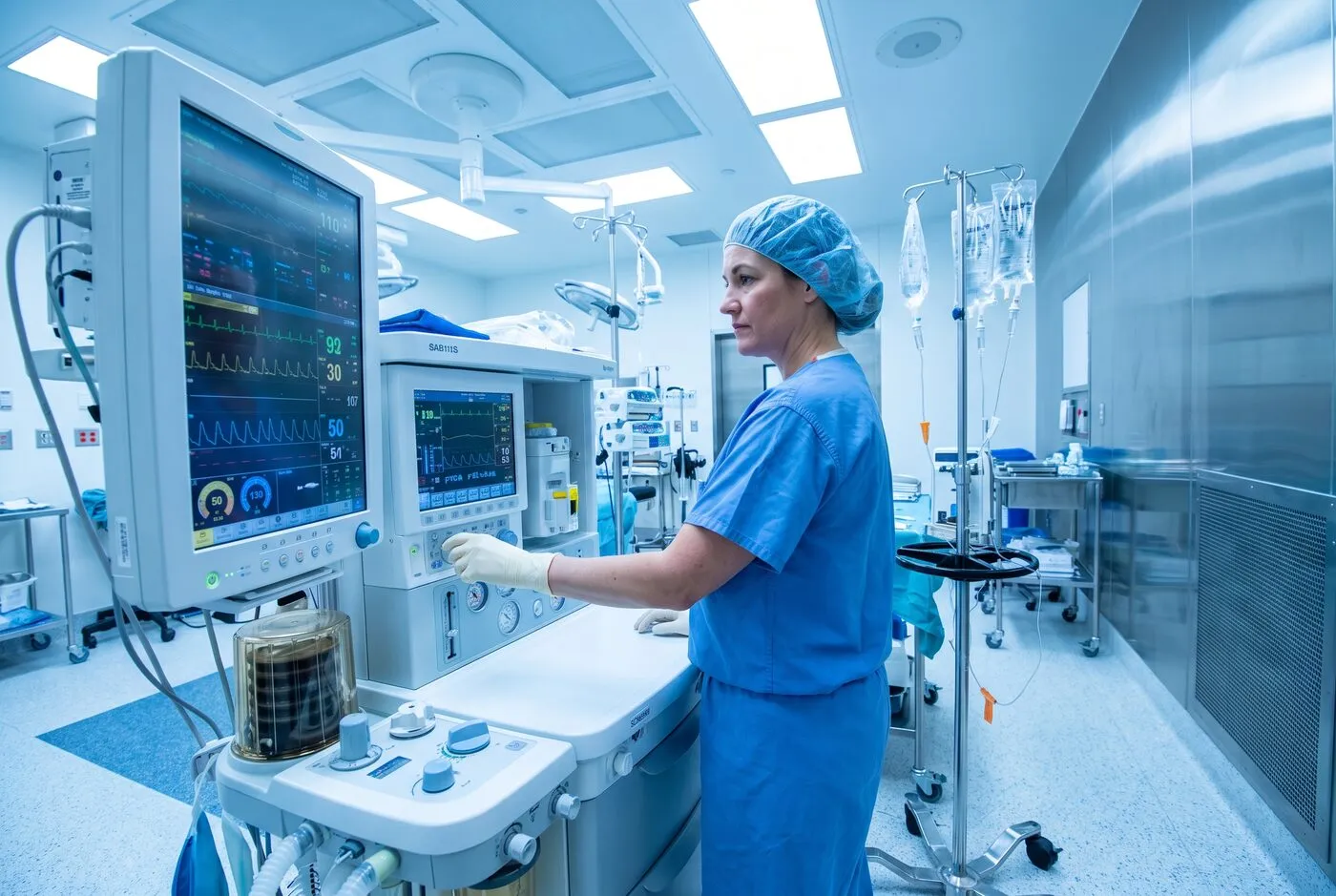
A CRNA is a nurse with a doctoral degree and national board certification who administers anesthesia. That includes pre-anesthesia patient assessment, selecting and dosing anesthetic agents, monitoring patients through surgery or a procedure, and managing recovery. CRNAs work in operating rooms, labor and delivery, pain clinics, and outpatient surgical centers. In many rural hospitals, they are the only anesthesia provider in the building.
The autonomy piece is the part the salary reflects. CRNAs can practice independently in roughly half of U.S. states, without physician supervision. In those settings, you are not assisting an anesthesiologist. You are the anesthesiologist equivalent. That scope of practice is why the pay is where it is. The $236,590 national median is not a clerical error. It reflects a clinical role that requires doctoral-level training, independent judgment, and a tolerance for high-stakes decisions in real time.
The nurse anesthetist career also has genuine job security built in. Anesthesia is not a job that gets outsourced or replaced by an app. Every surgery, every epidural, every sedation procedure requires someone with this training in the room. That combination of autonomy, compensation, and demand stability is what makes this path worth the years it takes to complete.
The Step-by-Step Path to Becoming a CRNA
Step one is a BSN. You need a Bachelor of Science in Nursing, not just an associate degree and RN license. Some programs have bridge pathways for ADN-prepared nurses, but you will need to complete a BSN before starting a nurse anesthesia doctoral program regardless. Plan on four years for a traditional BSN, or 2 to 3 years if you're going the RN-to-BSN route after already holding an associate degree.
Step two is passing NCLEX and getting your RN license. That is table stakes. The registered nurse career guide covers what to expect from the licensure process, but the exam itself is not where people get stuck on the CRNA path. What matters after licensure is where you work.
Step three is ICU experience. This is the real gate. Programs require at least one year of critical care ICU experience, but most accepted applicants have two to three. Not all ICUs are equal in the eyes of admissions committees, and not all RN experience counts. More on that in the next section.
Step four is a COA-accredited doctoral program. The Council on Accreditation of Nurse Anesthesia Educational Programs sets the standards, and you must graduate from one of their accredited programs to sit for boards. These programs award either a DNP (Doctor of Nursing Practice) or a DNAP (Doctor of Nurse Anesthesia Practice). Most run 28 to 36 months. The best CRNA programs vary significantly in clinical hours, pass rates, and program culture, so where you apply matters.
Step five is the NBCRNA National Certification Examination. Pass it, and you are a CRNA. From that point forward, you maintain certification through continuing education and a recertification cycle. Total time from BSN start to board passage: 7 to 8 years under a realistic, uninterrupted scenario.
The ICU Experience Requirement: The Gate Nobody Talks About Honestly
The ICU requirement is where a lot of RNs who want to become a CRNA get surprised. It's not just a checkbox that says "one year in critical care." Programs are specific about what counts, and admissions committees read between the lines of your work history.
Qualifying ICU settings typically include surgical ICU, medical ICU, cardiac ICU, cardiovascular ICU, and neuro ICU. Step-down units, progressive care units, emergency departments, and post-anesthesia care units (PACU) generally do not count as standalone qualifications. Some programs will consider PACU experience as supplemental, not primary. If your ICU experience is in a unit that sees low-acuity patients with predictable conditions, expect questions about it.
What programs actually want to see from your ICU time is clinical complexity. Can you manage a patient on multiple vasoactive drips? Have you managed a ventilator? Have you cared for patients with multi-system organ failure? Those are the skills that translate to anesthesia practice, and your letters of recommendation and clinical narrative need to demonstrate them, not just your job title.
The honest advice: if you want to become a CRNA, get your RN license and then go directly into the most complex ICU you can get hired into. Build your registered nurse career deliberately toward ICU complexity. A surgical trauma ICU is better positioning than a step-down unit, even if the step-down unit pays slightly more or has better hours. Your ICU years are an investment in your application, not just a paycheck.
Inside a CRNA Doctoral Program
COA-accredited nurse anesthesia programs at the doctoral level are full-time commitments. Part-time is not an option. You will not work clinical shifts on the side. The programs require it, and the workload enforces it. Expect to stop working as a staff nurse the day you start.
The clinical hour requirement is 2,000 hours minimum, by COA standard. Many programs exceed that. Those hours cover a breadth of anesthesia cases: general anesthesia, regional techniques, obstetric anesthesia, pediatric cases, cardiac cases, and neurosurgical cases. The case mix matters because your boards will test all of it, and your future employer will expect competency across settings.
The didactic curriculum covers pharmacology at a depth most nurses have never encountered, physiology and pathophysiology, anesthesia principles, equipment, and research methods for the doctoral component. The doctoral project (a clinical practice project or dissertation, depending on the degree type) adds time and workload on top of clinical rotations.
One thing to understand going in: CRNA programs are expensive. Tuition varies widely, but many programs run $80,000 to $150,000 in total cost. You are also giving up 2 to 3 years of ICU nurse income. That is a real number to factor into your decision. The payoff math still works (see the last section), but you should go in with clear eyes about what the cost side of the equation actually looks like.
How Competitive CRNA Program Admission Actually Is
Nurse anesthesia programs are among the most selective in all of healthcare graduate education. Acceptance rates at established programs commonly run between 10 and 20 percent. Some programs with strong reputations accept fewer than 10 percent of applicants in a given cycle. You are not competing against the general population of nurses. You are competing against other ICU nurses who also have strong GPAs, documented shadowing hours, and letters from physicians and CRNAs who know their clinical work firsthand.
What a competitive application looks like in concrete terms: a science GPA above 3.5, two or more years of complex ICU experience, a minimum of 40 to 80 hours of CRNA shadowing (some programs specify more), a graduate-level physiology or chemistry course taken within the past few years, and strong letters from people who can speak to your clinical judgment under pressure, not just your attendance record.
The GRE requirement is inconsistent. Some programs require it, some have dropped it. Check each program individually. Where the GRE is required, a combined verbal and quantitative score around the 50th percentile is a floor, not a target.
The parts that are harder to quantify but matter in interviews: can you articulate why anesthesia specifically, not just why you want a high-paying nursing job? Can you describe clinical scenarios from your ICU experience with the kind of detail that shows you understood what was happening physiologically? The programs are small (most cohorts are 20 to 50 students), so they are also evaluating whether you will contribute to the cohort and survive the program's culture. Apply to the best CRNA programs that match your stats, but apply broadly. A single-program strategy on a 10 percent acceptance rate is not a plan, it is a hope.
The Financial Payoff: Does the Math Actually Work?
Let's run the numbers directly. You spend roughly 7 to 8 years in training, including 1 to 2 years earning an ICU nurse salary (national median around $81,000) before the 3-year doctoral program where your income drops to zero or near it. Program tuition runs $80,000 to $150,000 at many schools. That is a real opportunity cost and a real out-of-pocket cost.
On the other side: a national median CRNA salary of $236,590 per year. That is roughly $130,000 more per year than the median RN salary. At that delta, you recover the income gap from your doctoral years in under 3 years of post-certification practice. The tuition debt, at $100,000 financed at 6 percent, runs about $1,100 a month for 10 years. On a $236,000 salary, that is manageable.
The real payoff is not just the dollar figure; it is the trajectory. CRNAs in independent practice states, or those who contract with surgery centers and rural hospitals, can earn significantly more than the median. The top 10 percent of earners exceed $239,000. CRNAs who move into group practice ownership or administrative roles in anesthesia departments can go higher than that.
Who should not do this: nurses who want a more predictable schedule, who are not drawn to the pace and stakes of the OR, or who are looking for the highest income relative to years of training. A nurse practitioner path takes fewer years and produces strong income. The CRNA path makes sense specifically for people who want to work in anesthesia and who can sustain the academic and clinical demands of a doctoral program. If that is you, the financial case for how to become a CRNA is one of the strongest in all of healthcare.