
RN to NP: The Full Path From Bedside to Nurse Practitioner
The math is simple: $34,750 more a year. The path is longer to explain than it is to walk once you know the six steps.

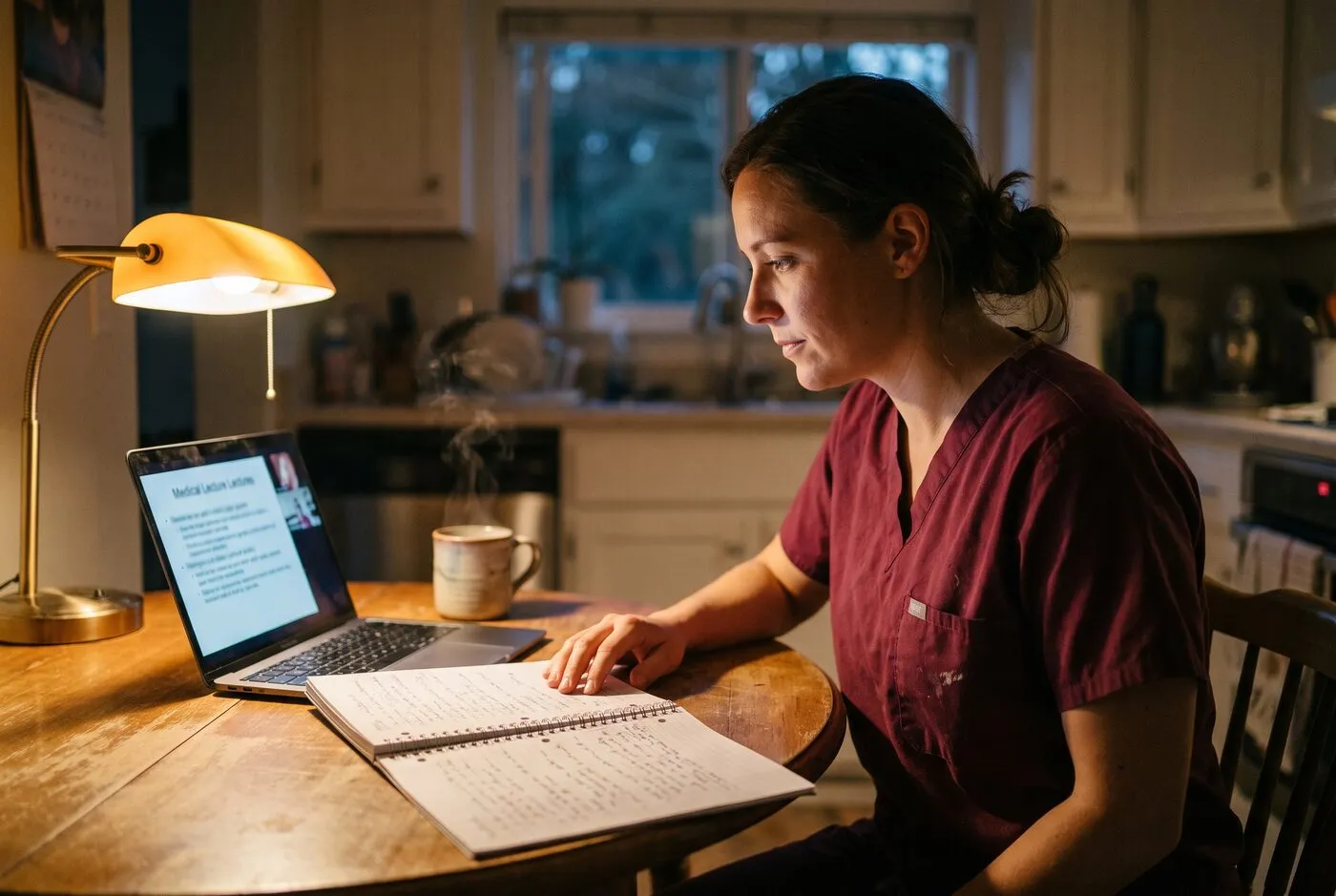
The rn to np jump adds $34,750 a year to your paycheck, moving the median salary from $97,550 for a registered nurse to $132,300 for a nurse practitioner, and it does that while NP jobs are projected to grow 45% from 2022 to 2032, one of the fastest growth rates the BLS tracks for any occupation.
That is the headline number. The real story is what it takes to get there and what you give up on the way. Most RNs who make this move do not quit bedside work to do it: they keep their RN paycheck, keep their shifts, and finish a graduate degree on their nights off. The rn to np path is not a leap of faith, it is a part-time, working-adult degree track with a clear finish line.
This page walks through the actual steps, the honest timeline for both ADN and BSN nurses, what happens to your schedule and your wallet while you are in school, and how to pick a specialty once you are certified.
Why the rn to np move pays off
Start with the math, because it is the reason this conversation happens at all. A registered nurse earns a median $97,550 a year. A nurse practitioner earns a median $132,300. That is $34,750 more every year, and over a 20-year NP career that gap adds up to roughly $695,000, undiscounted. NP jobs are also projected to grow 45% from 2022 to 2032, one of the fastest growth rates the BLS tracks, which means the rn to np jump is not a bet on a shrinking niche.
But money is not the only reason RNs make this move. As an NP, you diagnose, order tests, and prescribe, work that RNs support but do not own. You build longer relationships with patients instead of handing off at shift change. And you trade 12-hour bedside shifts, with the back pain and short-staffed nights that come with them, for clinic hours or a hospital role with more autonomy. To see where that autonomy tops out in real dollars, the nurse practitioner salary data breaks down NP pay by setting and experience.
Be honest about what you lose too. Bedside nursing has a camaraderie that clinic work often does not. Shift-work flexibility, three 12s and four days off, tends to disappear when you move to a Monday-through-Friday clinic schedule. Some RNs try the rn to np path, finish the program, and miss the unit more than they expected. That is a real outcome, not a hypothetical, and it is worth sitting with before you enroll.
The rn to np path, step by step
The rn to np path breaks down into six concrete steps. Where you start depends on whether you already hold a BSN.
- 1. Get your BSN if you do not have one. ADN nurses complete an RN-to-BSN bridge, typically 12 to 24 months online while still working full-time. Nearly every RN-to-BSN program is built for working nurses, so this step does not require quitting your job.
- 2. Pick a population focus. Family nurse practitioner, FNP, is the most common choice because it covers the broadest patient population and the broadest job market. Psychiatric-mental-health nurse practitioner, PMHNP, is the hottest specialty right now.
- 3. Enroll in an MSN or DNP program with an NP track. These run 2 to 3 years part-time for nurses still working full-time as an RN. Many are online for the didactic coursework, with clinical placements arranged locally. Compare options through the best nurse practitioner programs before you commit to one.
- 4. Log your clinical hours. Expect 500 to 750 or more supervised clinical hours on top of coursework before graduation.
- 5. Pass national certification. AANP or ANCC, depending on your population focus.
- 6. Get licensed in your state. This is the step that actually lets you practice as an NP.
Timeline-wise, an ADN nurse is looking at 12 to 24 months for the BSN bridge, then 2 to 3 years for the NP degree, so 3.5 to 5 years total for the full rn to np path. A nurse who already holds a BSN skips straight to the NP program and can finish in 2 to 3 years.
Can you keep working as an RN during NP school?
Yes, and most RNs do exactly this. The rn to np track is built around working nurses: MSN and DNP NP programs are largely online for lectures and coursework, with clinical placements handled locally near where you already live and work. You are not relocating to a campus.
The real scheduling crunch is not the coursework, it is the clinical placement semesters. Three 12-hour bedside shifts a week already eat your days off. Adding 15 to 20 clinical hours a week on top of that, during the semesters that require it, is where people struggle. The practical fix is to talk to your manager early about a temporary schedule shift: self-scheduling more nights or weekends during clinical semesters, then pulling back once you are on didactic-only terms again.
Here is the financial detail that changes the whole conversation: you keep your full RN paycheck through the entire program, because you are still working as an RN while you are a student. Nurses considering the rn to np jump often assume they will take a pay cut to go back to school. You will not. The only real cost is tuition, not lost income, which is a very different math problem than a full-time career change.
What the rn to np track costs, and the payback math
Nobody can give you one tuition number, because MSN and DNP NP programs vary widely by school and by whether you are in-state, online, or at a private university. What you can calculate on your own is the payback.
At an extra $34,750 a year in NP pay, every $35,000 of total program cost pays for itself in roughly one year of working as an NP. A $70,000 program pays back in about two years. Even nurses who take on debt to do this are usually looking at a payback window measured in single-digit years, against a career that can run another 10, 20, or 30 years.
The DNP question complicates the math slightly, since a doctorate takes longer and costs more than an MSN for the same NP scope of practice in most states. If you are deciding between the two, read MSN vs DNP before you enroll, because the extra time and tuition of a DNP does not always buy you a different job or a meaningfully different paycheck.
Who should not do this: nurses who genuinely love bedside work and would be miserable in a clinic chair doing documentation for eight hours a day; nurses who hate charting, since NP work is charting-heavy; and nurses within about 10 years of retirement, where the payback math still technically works but leaves a much thinner margin for error if the program runs long or you do not land an NP role right away.
Choosing your NP focus after rn to np
Family nurse practitioner is the default choice because it is the broadest market. FNPs work in primary care, urgent care, and specialty clinics nationwide, and nearly every hiring market needs them. If you want the widest range of job options after graduation, FNP is the safe, well-traveled choice.
Psychiatric-mental-health nurse practitioner is the specialty to watch. Telehealth has made PMHNP one of the easiest NP roles to practice remotely, and demand is outpacing supply in most states because there are simply not enough psychiatric prescribers. If that draws you, read up on the psychiatric nurse practitioner career before you pick your population focus, since PMHNP requires its own separate coursework and clinical hours; you cannot add it on later without going back for a post-master's certificate.
Acute care NP tracks exist for nurses who want to stay in the hospital, working with critically ill or post-surgical patients instead of moving to outpatient clinic life.
Whichever focus you choose, vet the program itself before you enroll. Check the school's certification pass rate for its most recent cohorts, ask how clinical placements are arranged, and confirm the program holds proper nursing accreditation, since an unaccredited program can block you from sitting for certification entirely. Start your comparison with the best nurse practitioner programs, then check what the finished path actually pays with the nurse practitioner salary breakdown by state and setting.